Alice in Wonderland King Arthur Legend of the Sword Art
How 'The Sword in the Stone' Pulled Walt Disney Back Into Animation
King Arthur's (lack of) success brought the dominate back into Disney animation.
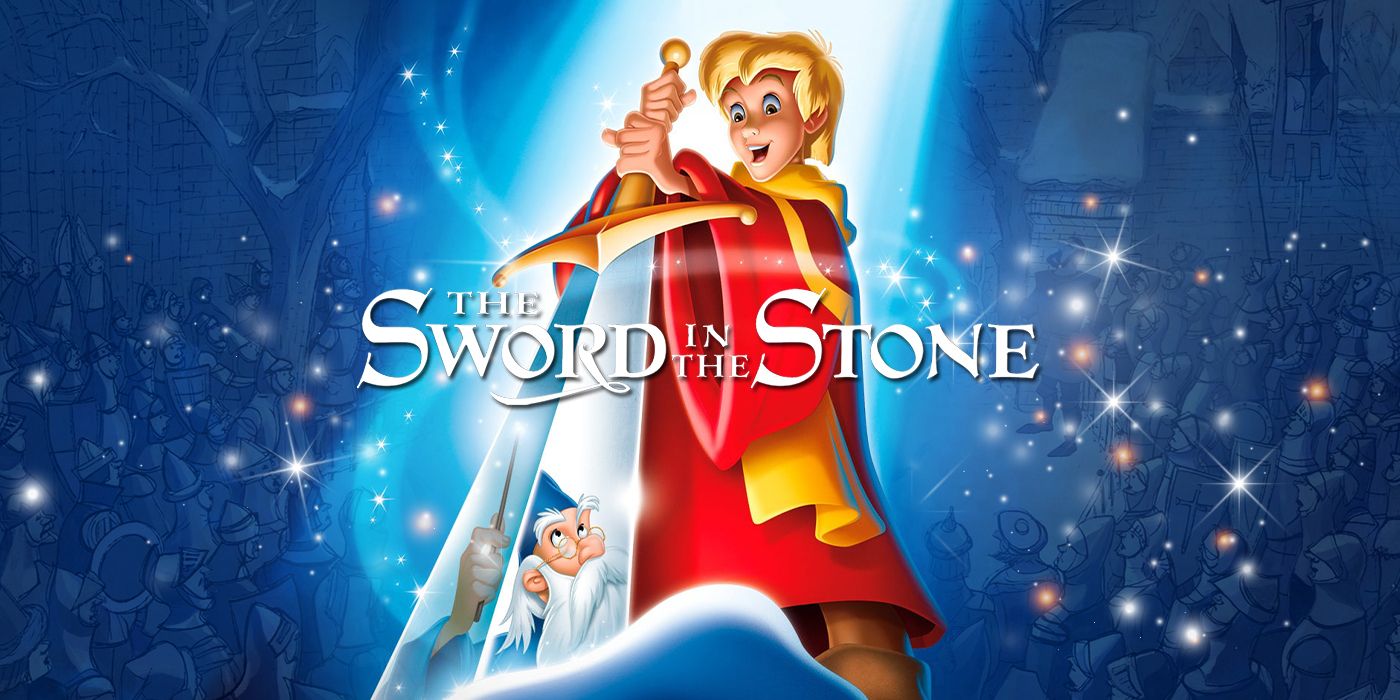
You would think Disney might have cornered the marketplace on Rex Arthur films. The studio's takes on Alice in Wonderland , Peter Pan , Winnie the Pooh , and Mary Poppins are so ubiquitous they've overtaken the British source cloth in pop culture, the studio's earliest forays into pure live-activeness filmmaking were made up of adaptations of British novels and legends, and Arthurian lore's collection of kings, castles, magic, and romance seems an ideal fit for Disney at first glance. But the Matter of Britain has nonetheless to have a movie that defines the legend for the medium of movie house in the way that, say, The Adventures of Robin Hood (1938) did. King Arthur adaptations have come up every bit musicals, spoofs, depression-budget trash, cult classics of debatable quality, and a string of recent efforts that just haven't defenseless the public's eye in a big enough way (best of luck to The Green Knight in that regard). And so there's Disney's one attempt at Arthurian legend, 1963'southward The Sword in the Stone, which did less for Arthurian movies than information technology did for Walt Disney Blitheness.
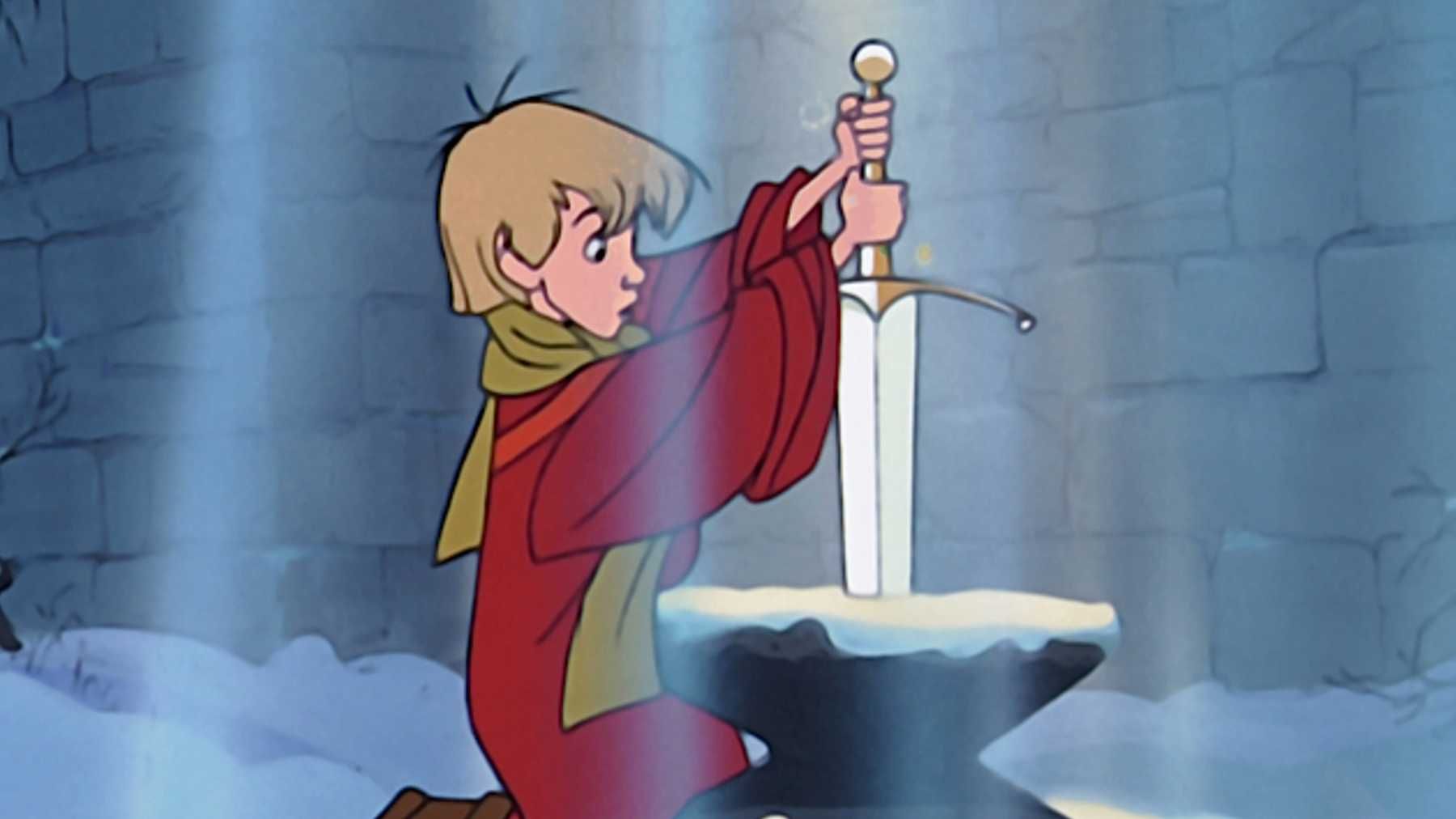
It wouldn't appear that mode at first glance. The Sword in the Rock isn't the most acclaimed of Disney'south catalog. It isn't the nearly pop. Information technology wasn't the most successful at the box role. Compared to the films produced in the 70s and 80s, the film has left a off-white-sized postage stamp on the Disney legacy; the sword itself is a popular photo op in the theme parks, and the moving-picture show's interpretation of Merlin has gone on to a decent-sized role in the Kingdom Hearts serial. And there are fans; my father'southward one of them and I was one of them as a kid, though these days I find the pic meandering and uneven. But whatsoever the individual members of my family think, The Sword in the Stone has never been the first thing that comes to most minds when you lot mention Disney animation or Male monarch Arthur.
Well, that may only be true for films, every bit far equally Rex Arthur is concerned. For generations of readers, The Sword in the Stone may be among the start titles they think of for Arthurian lore. Information technology's the showtime volume of The Once and Time to come Rex , T.H. White'due south tetralogy that reshapes the medieval Le Morte d'Arthur into a 20th-century reflection on morality, leadership, and war. The Sword in the Stone depicts Arthur's childhood equally the ward to a knight, unknowing of his lineage or destiny, given a magical teaching by the eccentric wizard Merlyn (and that is how information technology's spelled in the text). The 2d book, The Queen of Air and Darkness , contrasts the rising of Arthur every bit a young king and his attempts to apply Merlyn's lessons to his rule with the plight of his unknown nephews, who abound upwardly at the mercy of their unstable, scheming mother Morgause. Arthur continues to wrestle with how to be a adept homo and king in The Ill-Made Knight , just the third book is chiefly concerned with the doomed romance between Queen Guinevere and an insecure, disfigured Sir Lancelot. Finally, The Candle in the Current of air brings the tragedy to a close as Arthur'south bastard son Mordred turns the queen's affair confronting them, and the tetralogy ends with Arthur reflecting one concluding time on his youth with Merlyn before riding out to his decease. No less an adept on fantasy than George R. R. Martin has called The In one case and Future Rex "the definitive modern treatment of the Matter of Britain" and advocated for a multi-part film adaptation a la The Lord of the Rings .
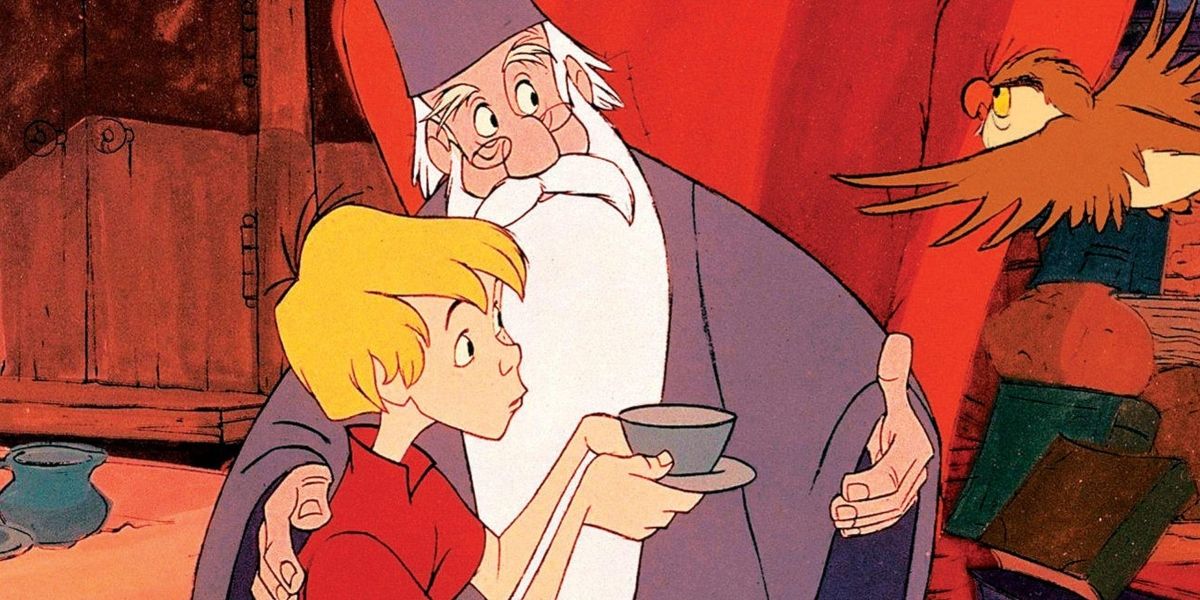
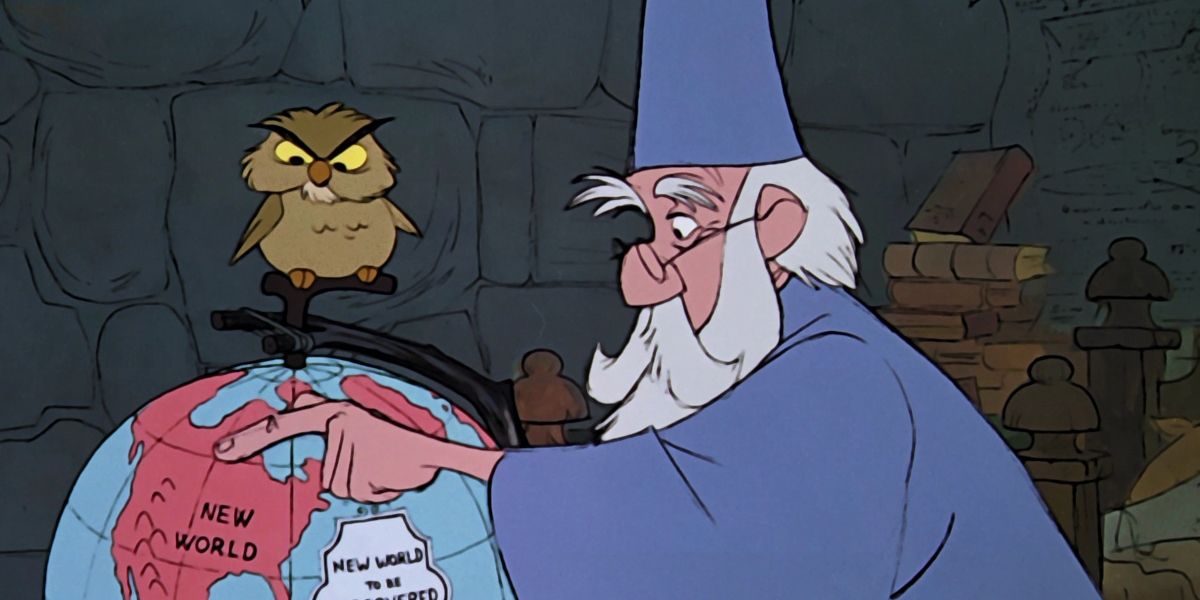
Different J.R.R. Tolkien, however, White didn't set out to tell an epic. When he start published The Sword in the Stone in 1938, it was a standalone tale meant for children, a fantasy of Merrie Olde England that bordered on parody. Merlyn in White'due south telling ages backward through time, making him cognizant of the future but easily confused between what has happened and what will happen. Anachronisms abound as Merlyn blusters nigh locomotives and swears he'll be blown to Bermuda. Meanwhile, immature Arthur encounters fairies, Robin Hood, and the mad Madame Mim earlier getting anywhere almost swords or stones. You won't find this edition in collections of The Once and Futurity King; White heavily revised The Sword in the Rock once he decided to expand it into a tetralogy, pulling it in a more philosophical direction that would tie into the afterwards books. It remains the most lighthearted of the four, but it should tell you something near how different they are when the magical duel between Merlyn and Mim is the centerpiece of the first edition, while a lesson taught by geese about the illusion of national borders fading away when viewed from above is the centerpiece of the revised story.
Only those revisions were decades abroad in 1938. The Sword in the Stone was all the same a piece of work of whimsy when Walt Disney took a shine to it. In the wake of his success with Snow White and the Seven Dwarfs in 1937, Walt was keen to line upward as many feature blithe projects as he could, and he acquired the rights to White'due south novel in 1939. That was about as far as any picture show version went for a few years. Pinocchio , Fantasia , and Bambi superseded it in going into production. Their underperformance at the box office, World War II, and a bitter animators' strike, all in the span of three years, derailed Walt'southward ambitions and left him uncertain and demoralized. Walt Disney Productions would limp through the 1940s on a series of package features and live-activity/animated hybrids. The Sword in the Stone, like many a potential movie Walt had considered, was no one'due south starting time priority. To say it lingered in development hell would imply that whatsoever significant work was done towards putting it into product. The occasional press release implied it was in evolution, simply no serious steps forward came until the 1960s.
Walt Disney Productions was a very unlike studio by so. From an independent cartoon producer, it had grown into a major studio with arms in live-activeness films, television set, and of course, Disneyland. These ventures commanded most of Walt'south interest, enthusiasm, and hands-on interest. The disappointments of the 40s lingered on for Walt, and he never fully recovered his passion for animation. His involvement with the feature cartoons of the 1950s was a downward tendency, to the animators' frustration, and as beloved equally these films accept get over the years, their reception at the time was hit and miss. On summit of that, the cost of producing blithe films kept rising. Things came to a caput in 1959, when Sleeping Beauty toll $vi meg, $56 meg in today'due south money. If that still doesn't seem like much, consider that Sleeping Beauty was amid the x highest-grossing films of 1959, and nevertheless couldn't recoup its production and marketing costs.
Against those stark figures, Walt'south older blood brother and business partner Roy O. Disney pressured him to shutter the animation department. In that location was no more than need, he argued; they'd made enough cartoons that they could sustain that legacy through theatrical reissues. Walt refused, but he did concede to economics. Staff was reduced and the ink and pigment department was replaced with a method for xeroxing drawings onto cels. If these concessions weren't enough for Roy, so the critical and popular success of 101 Dalmatians secured the life of the blitheness department, at to the lowest degree in the short term.
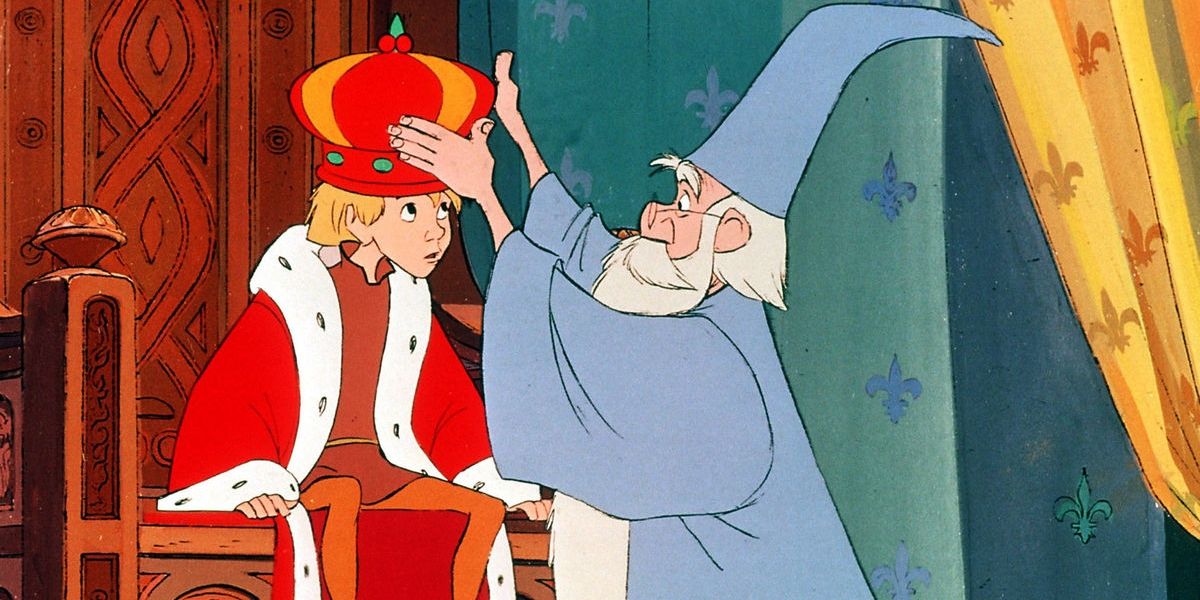
But Walt'south disengagement from blitheness was probably at its strongest during this time. He had piffling involvement with 101 Dalmatians. The story development process was traditionally handled by a group of artists led or at least supervised by Walt himself. On Dalmatians, there was only one story homo: Bill Peet, a Disney veteran of nearly 30 years. Peet single handedly storyboarded the entire moving picture, and its success gave Peet an unusual amount of clout at a studio where everything operated on its namesake'due south pleasure. Tasked with developing the adjacent animated characteristic, Peet dusted off The Sword in the Stone. By that time, the rest of The One time and Hereafter King had been published, and the shift in tone was obvious. There was fifty-fifty another adaptation extant: the musical Camelot , loosely derived from the final 2 books. Taking in a performance of Camelot helped convince Walt to greenlight The Sword in the Stone. But Peet shied away from White'due south later, heavier fabric. "Nosotros decided to brand it playful considering almost everyone knows the story," he said. "In that location had already been as well many Knights of the Circular Table epics and that was not for u.s.." Confronting mutual practice for animation at the fourth dimension, Peet wrote out a screenplay before storyboarding the film, to help in "sorting and sifting" the novel into a directly storyline. Walt weighed in with a asking for "more than substance," but his greatest contribution may have been without his noesis or consent: Peet patterned the nose, the playfulness, and the atmosphere of Merlin (the film does not use White's spelling) after Walt himself, office of a trend among Disney animators of basing benevolent but ill-tempered authority figures on their dominate; the magician Yen Sid in Fantasia was made in Walt'due south paradigm besides).
By 1960, Peet had his script boarded and ready to move on. In that location was only one problem: the animators didn't want information technology.
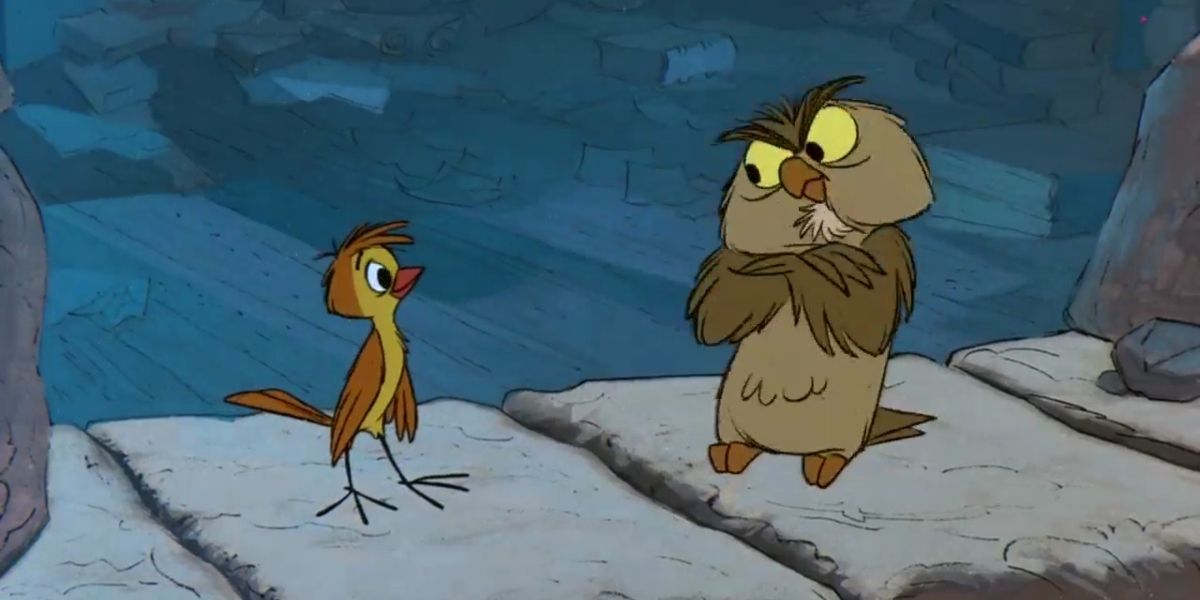
A group of them, led by animator Marc Davis and art director Ken Andersen, wanted to tackle another contemporary setting after Dalmatians, and thought that they had a vehicle in an updated and Americanized version of the French play Chantecler , virtually a Gallic rooster who thinks his crowing makes the sun rise. Information technology was another project that dated back to the late 1930s, one that had been abandoned multiple times when the story failed to come together. Just the animators promised Walt a fresh arroyo, and a squad of six spent six months developing it. Peet was enlightened of Chantecler, only he didn't share in the enthusiasm for it. "It's just a little too weird," he told the team. "They all got pretty aroused with me."
This wouldn't have been a problem in years past; Disney had multiple animated projects in the works from the time of Snowfall White. But Roy'southward pressure on Walt continued, and and so did the need to cut costs. Walt stood firm in refusing to close downward animation, but he agreed to scale back product from a film every two years to every 4. This meant that, of the 2 pictures he had lined up, but one could get forward, and no such decision happened at Disney by anyone except Walt. Peet and the Chantecler squad would need to give a prove-and-tell on the work they'd done.
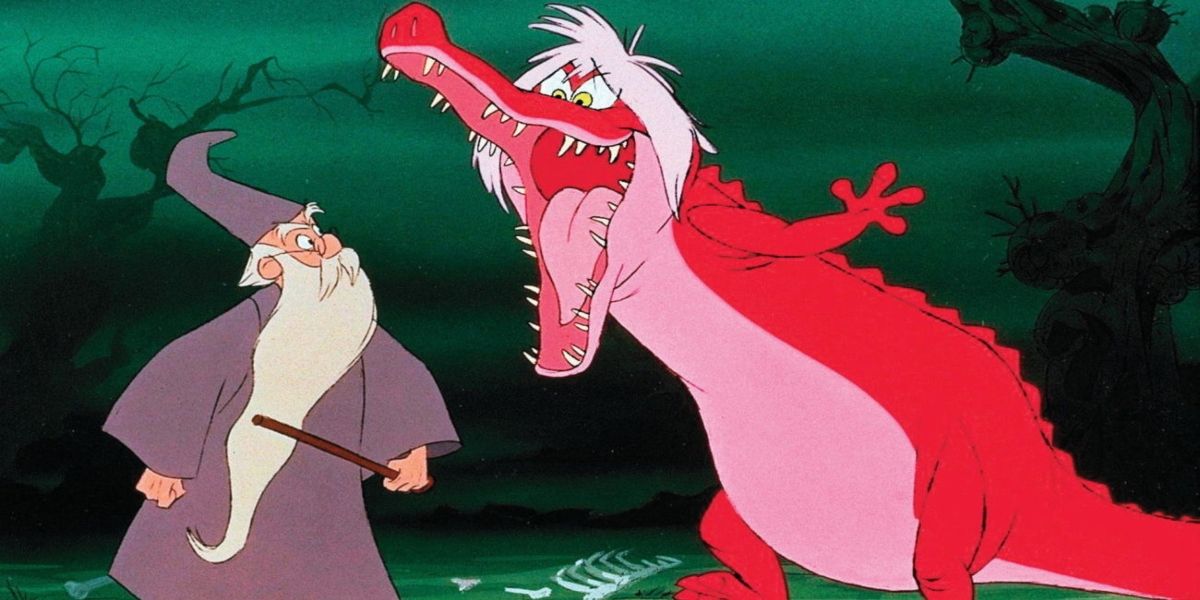
Accounts vary on what happened adjacent. Walt was notorious for slipping into offices at night to get an early on look on work being done at the studio. He apparently did then with his competing animated projects, and came to the conclusion ahead of the pitch sessions that The Sword in the Stone was the moving-picture show that would move forward. In the Marc Davis version of the story, Walt couldn't bring himself to tell Davis and Andersen, 2 long and loyal employees he was very fond of, that he wasn't advancing Chantecler. He let one of Roy's workers derail the story pitch with a put-down, walked out without a discussion, and afterward offered Davis more rewarding work away from animation. In Pecker Peet's rather self-congratulatory business relationship, Walt did take something to say in the Chantecler pitch: "Just one give-and-take – shit!" before leading anybody into Peet's office to come across The Sword in the Stone.
"Here come all of these people," recalled Peet. "They were all sulking and hoping I'd fall on my face…when I was done, Walt asked them what they thought – pretty adept, huh? And they said, 'Oh yeah!' Yous can imagine how humiliated they were to accept defeat and give in to Sword in the Stone…[Walt] allowed them to take their own way, and they let him down. They never understood that I wasn't trying to compete with them, only trying to do what I wanted to work."
But the conclusion may non take been equally merit-based as Peet liked to advise. His adaptation of The Sword in the Stone was more appealing to Walt's sensibilities than Chantecler; Arthur, a bright-eyed youth saddled with the humiliating nickname "Wart" and bullied by his foster blood brother, was a more sympathetic pb than a pompous, delusional rooster. But Peet had likewise significantly pared back the number of characters from White's novel. The fairies, Robin Hood, fantastic beasts, and multiple adventures in the animal kingdom were excised. Despite the remaining animal sequences and the magical battle between Merlin and Mim, most of the characters were humans with straightforward designs that wouldn't be likewise challenging to animate. The musical numbers were few and unambitious in staging. What this all meant was that The Sword in the Rock was the less expensive selection at a fourth dimension when cost concerns were paramount.
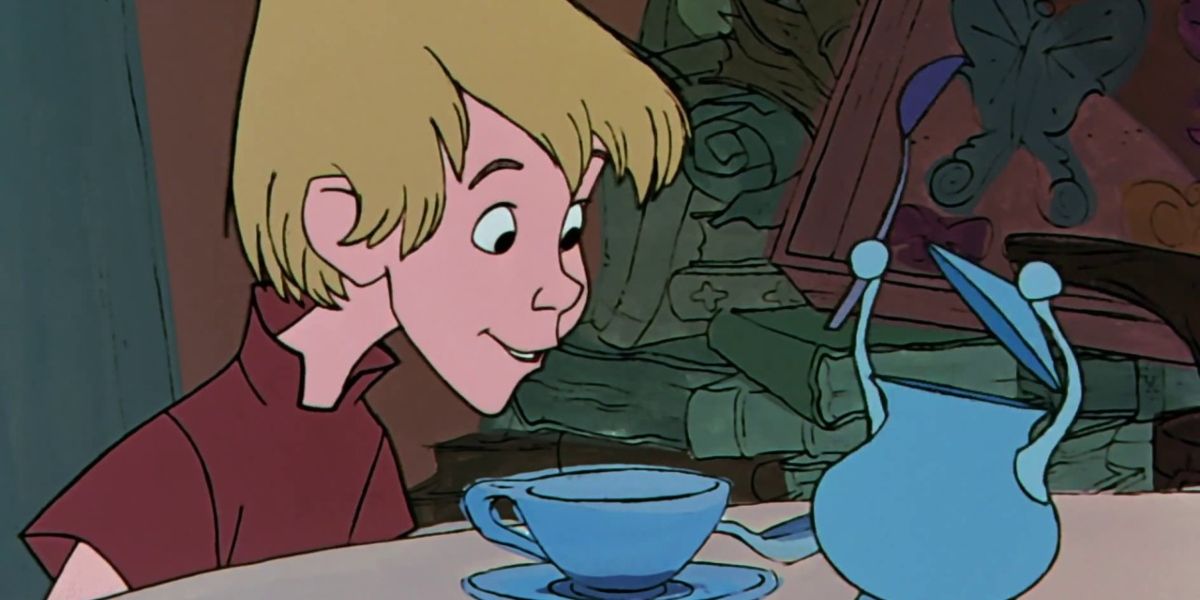
The film all the same managed to cost almost as much as 101 Dalmatians, and while information technology made coin at the box office, revenue was down, and reviews were mixed. Even within the studio, in that location were misgivings. Director Woolie Reitherman was reluctant to work on the picture from the commencement, songwriting squad the Sherman brothers reflected that their songs were disconnected from the underscore and the narrative, and even Neb Peet admitted that the film hadn't turned out as well as Dalmatians. Merely most of all, the underperformance of another characteristic cartoon had Walt worried, enough so that he wanted a much greater say in the adjacent one after years of neglecting them. He had agreed to Bill Peet's suggestion of The Jungle Book as the next blithe film, and left Peet alone to develop it, only when he finally saw the first storyboard, he was not happy. "This wasn't the first time Walt and [Peet] had clashed," recalled story artist Floyd Norman, but it was the last. Peet left the studio, and his brooding take, more faithful to the Rudyard Kipling book, was supplanted by a light and informal film that led with character, a management set firmly by Walt. Biographer Bob Thomas wrote that Walt contributed to story sessions on the picture show with a zeal non seen since his earliest days working on Mickey Mouse shorts, and in the making-of documentary for The Jungle Book DVD, an animator recalled Walt maxim in his last story meeting before his expiry: "Gee, guys, I had forgotten how much fun this is!"
As for The Sword in the Stone, information technology had its theatrical reissues and TV airings, and so its release to home video and streaming services. Information technology still has its fans – when I told him I was writing this, my dad started looking for the DVD. And even the center-tier Disney titles tin can't escape the curse of the live-action remake. Announced in 2015, that project has however to begin product. Given the track record of these remakes to engagement, one may reasonably expect some other forgettable retread that might likewise accident off to Bermuda. Just there is e'er the take a chance, all the same slight, that an eccentric filmmaker can get attached, crack the lawmaking to a definitive Arthurian movie, and pave the way to that full and proper adaptation of The In one case and Future Male monarch George R. R. Martin nevertheless hopes for.
About The Author
.png?fit=crop&w=100&h=100)
Source: https://collider.com/sword-in-the-stone-disney-animation-history/
0 Response to "Alice in Wonderland King Arthur Legend of the Sword Art"
Post a Comment