Untitled Early 1940s Oil on Canvas 351?6 X 24 in National Gallery of Art Gift of T
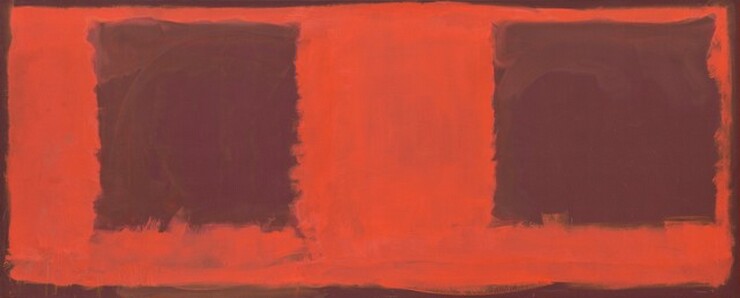
Mark Rothko, Untitled (Seagram Mural sketch), 1959, oil and mixed media on canvas, Gift of The Mark Rothko Foundation, Inc., 1986.43.156
Hither Rothko turned to a palette of red, maroon, brown, and black. The artist somewhen withdrew from this project, due to misgivings about the eatery as a proper setting for his work. He had, however, already produced a number of studies and finished canvases, ii of which are included in the present installation.
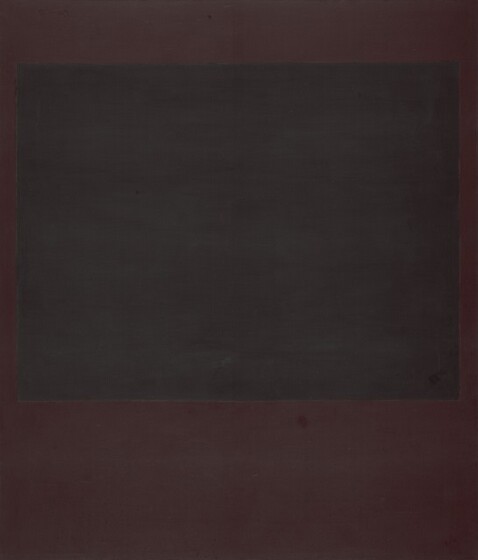
Mark Rothko, No. iv, 1964, mixed media on canvas, Gift of The Mark Rothko Foundation, Inc., 1986.43.152
With some exceptions, the darkened palette connected to dominate Rothko's work well into the 1960s. He developed a painstaking technique of overlaying colors until, in the words of art historian Dore Ashton, "his surfaces were velvety as poems of the night."
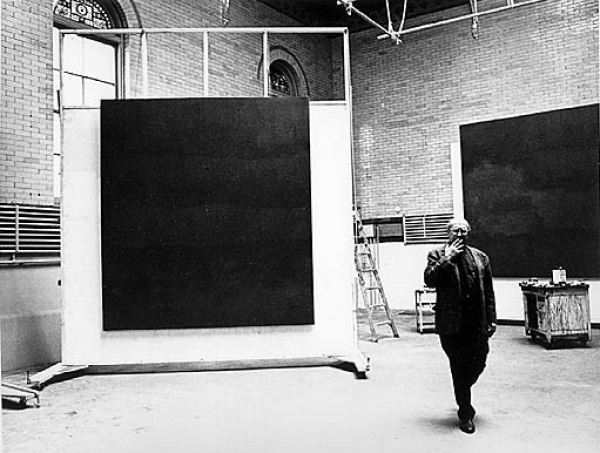
Rothko in his 69th Street studio with Rothko Chapel murals, c. 1964, © Hans Namuth Estate, courtesy Center for Creative Photography, The University of Arizona
His work on the Rothko Chapel paintings, originally commissioned by John and Dominique de Menil for the Academy of St. Thomas in Houston, Texas, occupied Rothko between 1964 and 1967. In turning abroad from the radiance of the previous decade, Rothko heightened the perceptual subtlety of his paintings, making distinctions betwixt shape and basis more than difficult to discern. He likewise transformed the touch his canvases have on the experience of space, which is now characterized by a awareness of enclosure. This quality, which lends itself to meditation, tin can exist clearly related to the spiritual nature of a chapel.
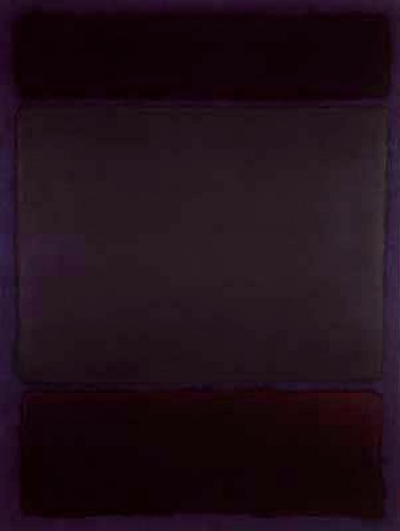
Marking Rothko, Untitled, 1968, Private Collection
Rothko'due south reading of Nietzsche, the 19th-century German philosopher, suggests that his work could represent the opposition between a rational or abstract chemical element and an emotional, central, or tragic 1 (referring to Nietzsche's discussion of the polarity between an Apollonian and a Dionysian principle). Certain qualities, such as radiance or the duality of light and dark, have a symbolic meaning in Western culture from which Rothko clearly drew. An impression of vast space is said to represent the historical concept of the "sublime," a quasi-religious experience of limitless immensity. The installation of these canvases likewise produces its own sacrosanct environs.
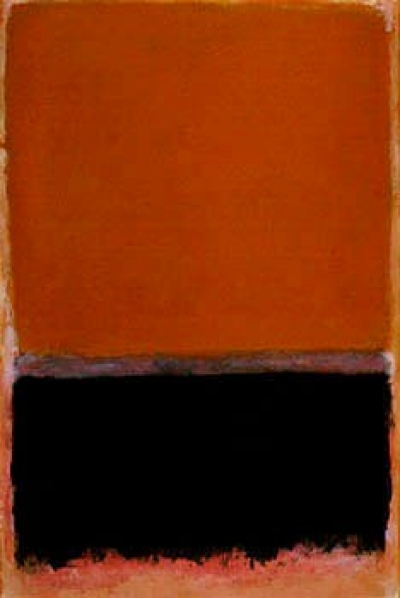
Marking Rothko,Untitled, 1953, Individual Collection
At different times during the 1950s and 1960s, Rothko produced a substantial quantity of modest works on paper. It is not certain whether these are studies for larger paintings or just smaller variations employing a similar dynamic of form and color. Rothko had many of them mounted on panel, canvas, or board in lodge to simulate the presence of unframed canvases. The smaller format especially suited Rothko in 1968, when his physical activeness was dramatically curtailed by a heart disquiet. Rothko continued to piece of work predominantly on paper fifty-fifty after he returned to a relatively large format in 1969.
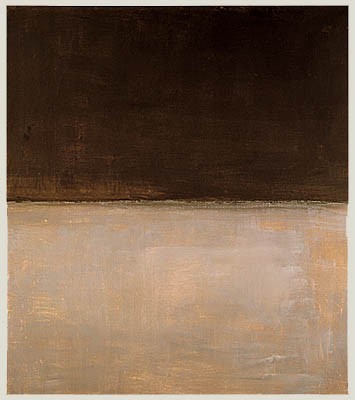
Marker Rothko, Untitled, 1969, John and Mary Pappajohn, Des Moines, Iowa
In a serial of chocolate-brown- or blackness-and-grey paintings produced from 1969 to 1970, Rothko divided the composition horizontally and framed the paradigm with a white margin (created past masking the edges of the paper or sheet with tape that was later removed to betrayal the blank support). The serene night zone stands out against the turbulent brushwork of the gray section, an expanse further modulated past the addition of ochre or blue. The sharply defined edge establishes a complex interplay betwixt the work and the viewer, who is drawn into the painting by its sensuous surface, yet kept at a distance by the stark framing device.
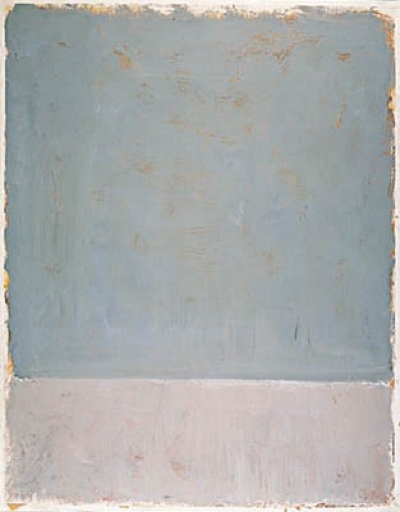
Marker Rothko, Untitled, 1969, Drove of Kate Rothko Prizel
In another series from this period, Rothko used a softer range of pinkish and bluish for compositions that sometimes remember smaller works from the mid-1940s. A certain ascetic quality suggests that Rothko had embarked on a new management, i which may have been related to the reductive work of younger artists at that time. Dissimilar the minimalists, still, Rothko never abandoned his conviction in the ability of abstract fine art to be experienced in emotionally expressive terms.
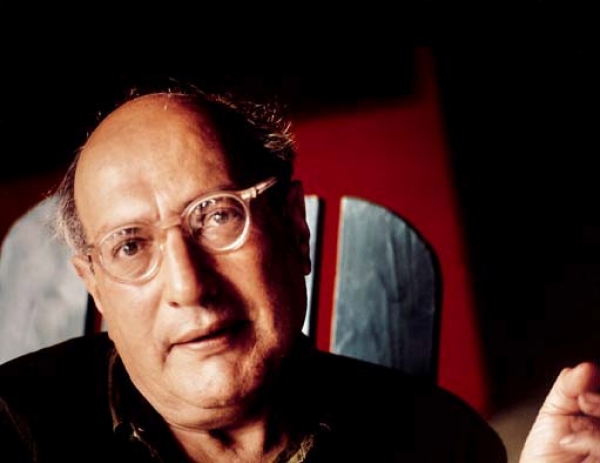
Mark Rothko in his studio, c. 1964, © Hans Namuth Manor, courtesy Center for Creative Photography, The University of Arizona (provided past Archives of American Art, Hans Namuth Photographs and Papers)
Physically ill and suffering from depression, Rothko committed suicide on February 25, 1970. At the time of his decease, he was widely recognized in Europe and America for his crucial office in the evolution of nonrepresentational art. His vibrant, disembodied veils of color asserted the ability of nonobjective painting to convey strong emotional or spiritual content. With an unwavering commitment to a singular artistic vision, Rothko celebrated the near-mythic power art holds over the creative imagination.
This spider web feature originally was produced in conjunction with the exhibition Mark Rothko, on view at the National Gallery of Art from May three to Baronial 16, 1998. Sponsored past Mobil. The exhibition traveled to the Whitney Museum of American Art, New York, September 17–Nov 29, 1998, and to the Musée d'Art Moderne de la Ville de Paris, Jan 14–April 18, 1999.
The following notice appears at the request of the artist's heirs: Works by Marking Rothko © 1998 Christopher Rothko and Kate Rothko Prizel.
Exhibition Credits (1998)
Curator:
Jeffrey Weiss, associate curator, 20th-century art, National Gallery of Art. Consultants for the exhibition are Marker Rosenthal, curator of 20th-century art, Solomon R. Guggenheim Museum, New York, and David Anfam, author of the forthcoming Rothko catalogue raisonné.Publication: A fully illustrated catalog has been copublished by the National Gallery of Art and Yale Academy Press, with contributions from John Gage, Carol Mancusi-Ungaro, Barbara Novak, Brian O'Doherty, Marker Rosenthal, Jessica Stewart, and Jeffrey Weiss. Information technology also includes interviews with Ellsworth Kelly, Brice Marden, Gerhard Richter, Robert Ryman, and George Segal about Rothko's artistic legacy.
Arrangement: The exhibition has been organized by the National Gallery of Art.
Sponsor: The exhibition is sponsored by Mobil.
Schedule: National Gallery of Art, May iii–Baronial 16, 1998; Whitney Museum of American Art, September 17–Nov 29, 1998; Musée d'Fine art Moderne de la Ville de Paris, January 8–April eighteen, 1999
Works past Marking Rothko in the National Gallery's Permanent Collection
The National Gallery of Fine art maintains the largest public collection of art by the American creative person Mark Rothko (1903–1970). In 1986 the Marking Rothko Foundation determined that its mission to conserve its drove of Rothko's art and to enhance and promote the artist's legacy through scholarly research and exhibitions would be best served by strategically placing his canvases and works on paper in selected major international museums. Before disbanding in the same year, the Foundation designated 35 institutions to receive the art. As the main recipient of the Marking Rothko Foundation's largesse, the National Gallery of Art received more than ane,100 works—paintings on sheet and works on paper—as well as research materials, including conservation records and exhibition reviews.
View a complete list of works past
Source: https://www.nga.gov/features/mark-rothko/mark-rothko-classic-paintings.html
0 Response to "Untitled Early 1940s Oil on Canvas 351?6 X 24 in National Gallery of Art Gift of T"
Post a Comment